
Lessons for Evangelism from the Data
The UK was asked what is missing from their lives, and the results offer churches encouragement and boldness for their evangelistic efforts.

There are just a couple of months to go until Easter. Which also means there are just a couple of months until the A Passion for Life Easter mission.
Hundreds of churches across the UK will join the week of mission in an effort to reach people in their communities with the good news of Jesus.
FIEC has been a significant financial backer of this initiative, which seeks both to equip churches for ongoing gospel mission and to encourage a period of focused evangelism. A Passion for Life’s Mission Director, Nick McQuaker, has compared it to a rowing crew upping their stroke rate for a period of time.
I was the National Co-Chair of A Passion for Life in 2010 and 2014, and as we approach this next mission period, I am encouraged that the spiritual landscape of the UK seems to be indicating a greater openness to Christianity.
This was suggested by the Bible Society’s Quiet Revival research and is confirmed by a new national survey undertaken on behalf of A Passion for Life, interviewing more than 2,000 adults from across the UK. The data from this survey will help churches to focus their evangelistic efforts more effectively, and also encourage congregations to have greater boldness in evangelism.
Church attendance
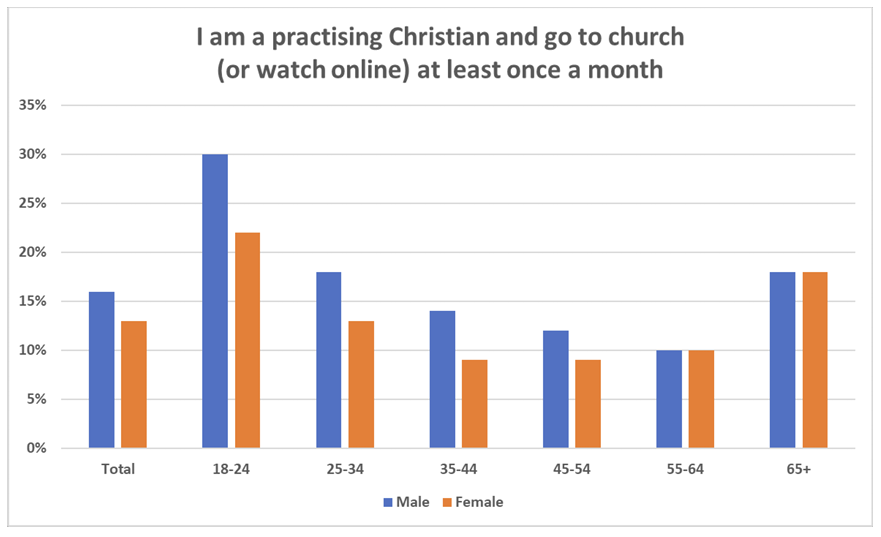
The survey suggests that an even higher percentage of people are regular church attenders at least once a month (in person or online) than the Quiet Revival survey claimed. The average across all age groups and sexes was 15%, compared to 12% in the Quiet Revival. 30% of men aged 18-24 reported monthly attendance. The lowest regular attendance was amongst those aged 35-64. The higher figures are probably a refelction of the inclusion of Northern Ireland and Scotland in the survey (The Bible Society only surveyed England and Wales).
Interest in knowing more
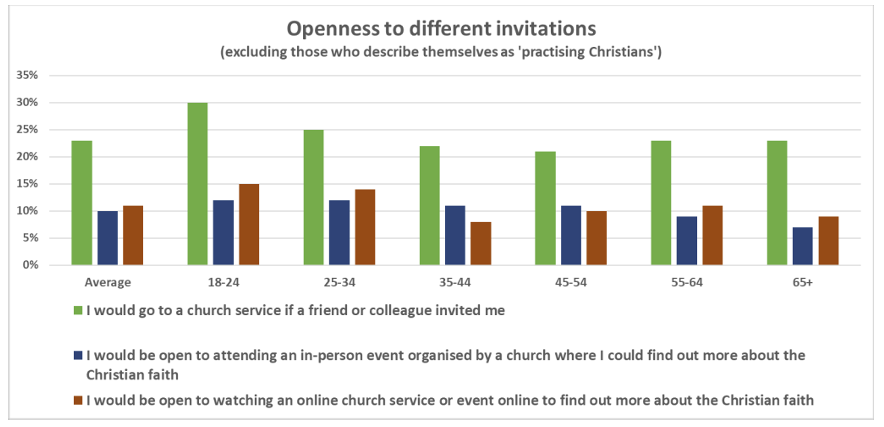
Encouragingly 20% of people expressed interest in knowing more about Jesus Christ and the Bible. More than 50% said they know a practising Christian, and more than 20% said they would go to a church service if invited by a friend.
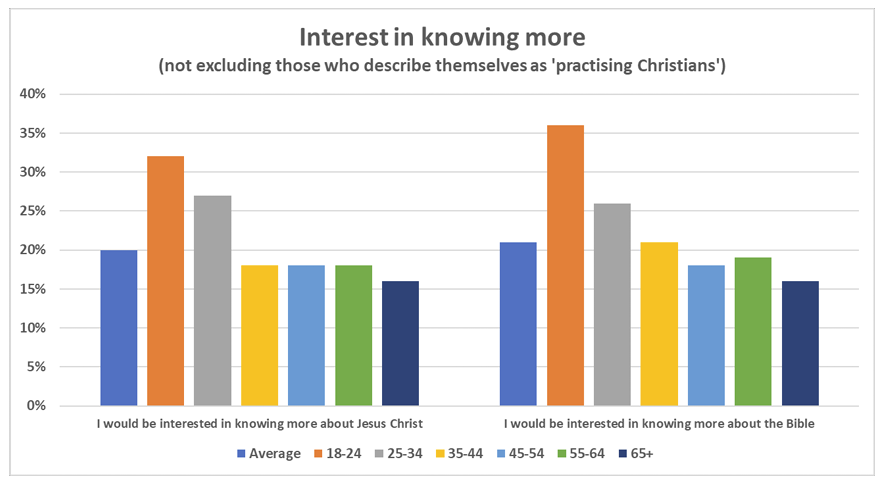
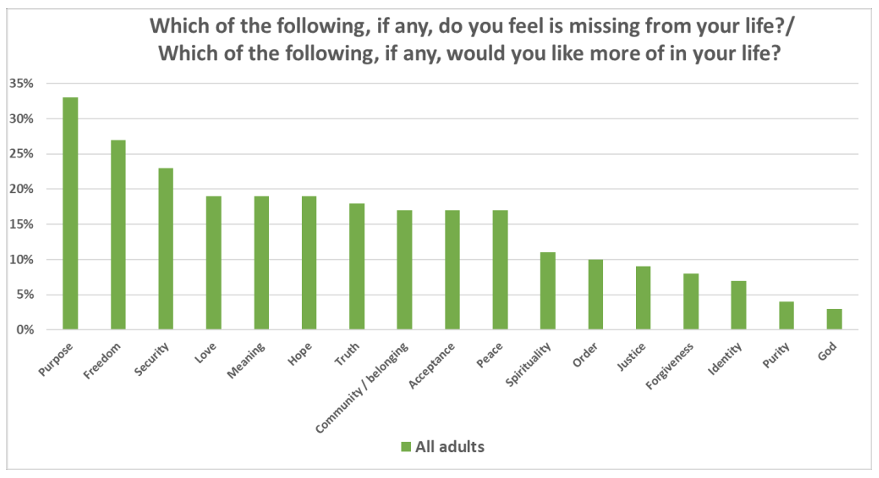
Particularly helpful for churches are statistics revealing what people feel is missing in their lives. The top three are: purpose, freedom, and security. Purpose was the stand out answer at over 30%, and 40% for 18-24s.
Love, meaning, hope, truth and community/belonging were at 17-20%. somewhat surprisingly spirituality, order, justice, forgiveness, identity, and purity came in much lower down. Most pertinently of all, only 3% said they felt God was missing from their lives.
There are lessons that we can learn from this survey for our churches, and especially how it can help church leaders to encourage their congregations in evangelism.
Evangelism is not so difficult
The survey results remind us that evangelism need not be as difficult or intimidating as we often make it.
Many more people are open to a conversation or an invitation than we assume. We can inadvertently discourage people from evangelism by suggesting that they will face hostility, so that the key quality we say they need is courage.
The survey suggests we should be more positive and give people a vision for the opportunity and possibility of evangelism. They may be talking to one of the 20% who would be interested in finding out more!
We need to help people to step out in faith and expectation of opportunity, not put them off by pre-emptive defensiveness and fear.
Don’t compare ministries
The survey reminds us that some ministry contexts will be harder than others, and so we cannot compare the fruit of our mission efforts with those of churches in different communities.
There is more openness and interest amongst young people, so it is not surprising that there is greater growth and impact in London, bigger cities, and university towns.
The least interested group are the middle-aged (35-64) who make up the bulk of the population in the communities of many churches. Those churches are sowing on stonier ground, and need to bear this in mind as they plan and reflect on the results.
We need to have both faith for more and a realism about the context.
Connect with the gospel
The survey reminds us of the need to preach the gospel to connect with those we are seeking to reach, ensuring that it is addressing their felt needs.
This does not mean that we do not expose their real needs, but we need to begin with what they already know they need, and show how this is a result of their spiritual condition.
In the gospels and Acts, almost every evangelistic encounter begins with Jesus or the apostles addressing a person’s evident need, whether physical or spiritual, or capitalising on their current search for spiritual truth.
We can easily assume that we know what people’s felt needs are, often because these are our own felt needs or the felt needs of the Christians we spend most of our time helping. But preaching to these needs may not resonate with unbelievers.
It is clear that the greatest need for most is the existential desire for purpose and meaning. The survey suggests that people are not directly looking for God, and they do not feel his absence.
Instead, we need to patiently show them how the absence of God might be the very reason for the felt needs they experience.
Mission is urgent
For all the positives it contains, the survey ought to remind us afresh of the urgency of the task of mission and the immense need of our nation.
Whilst there is increased church attendance and openness, it remains the case that only 3% or so of the 65 million people living in the UK are born again believers in the Lord Jesus. There is no room for complacency or inaction.
People are burdened by cares and concerns and are unknowingly headed for hell. We alone have the message that can save them.
The survey ought to drive us to prayer that God will have mercy on our land and work a mighty revival by his Spirit, and to take comfort that it is the gospel alone which is the power of God for salvation.
I pray that the A Passion for Life mission will see greater fruitfulness in conversions in this changed context than in previous mission periods.
It is not too late for churches to get involved and make the most of this opportunity. There are excellent resources available on the A Passion for Life website that both envision and equip congregations for evangelism, and make organising and advertising mission events easy.
I hope that the mission will refocus churches on our primary task of evangelism and saving the lost, and that it might result in a lasting culture of ongoing evangelism. I hope that the intensified effort of increasing our stroke rate of short period might lead to perseverance in rowing with more determination and enthusiasm when the mission itself is over – to use Nick’s comparison from earlier.
Photo by Priscilla Du Preez 🇨🇦 on Unsplash


