
Is the Evangelical Church in the UK Growing?
Two recent surveys exploring the beliefs and practices of the UK population evidence encouraging signs of gospel growth.

Since the end of the Covid pandemic, the ‘season’ for gospel ministry in the UK seems to have changed.
Many of our FIEC churches have been reporting growth, with newcomers and new believers joining their congregations. However, there has been little hard data to back up this impression. Reliable statistical information on the number of evangelicals in the UK has long been lacking.
FIEC has taken the widespread view that there are around 2-3% evangelical believers out of a population of 64 million - but this is essentially educated guesswork.
The Bible Society's ‘Quiet Revival’ research, undertaken by YouGov, claimed a surprising increase in church attendance, which attracted much attention and hope. But this was subsequently withdrawn due to questions over the reliability of the responses to their survey.
However, two more recent surveys that are methodologically robust have been published this month. Both surveys point to the growth of evangelical Christianity and remind us not to believe the secular narrative that Christianity and the church are in terminal decline.
The Surveys
Understanding UK Evangelicals
The Evangelical Alliance (EA) Understanding Evangelicals survey asked a large sample of people about their beliefs, practices, and self-identification to assess whether they are evangelicals.
They utilised the four elements of the famous ‘Bebbington quadrilateral ’, which defines evangelicals by key characteristics:
- Their commitment to the Bible
- The centrality of the cross
- The need for personal conversion
- Activism as a result of their faith.
The survey asked whether people agreed with these core beliefs and whether they self-identified as evangelicals.
Based on answers to these questions, they grouped people into various evangelical categories:
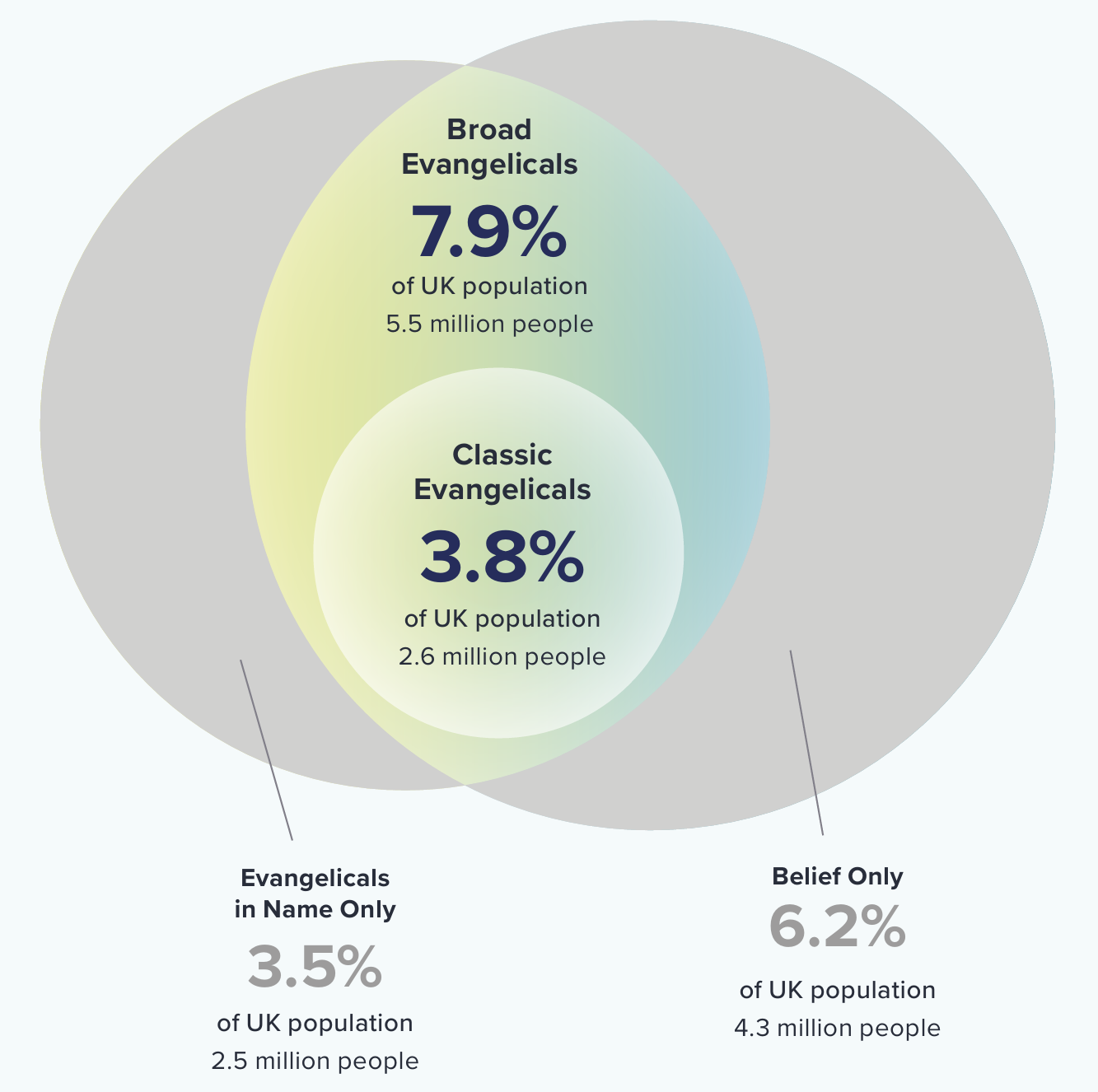
- ‘Classic Evangelicals’ were 3.8% of the population. They strongly held evangelical beliefs and identity, and were Protestant Christians.
- ‘Board Evangelicals’ were 7.9% of the population. They held evangelical beliefs and identified as evangelicals, even if they did not use the term.
- ‘Belief Only Evangelicals’ were 6.2% of the population. They agreed with evangelical beliefs but did not identify as evangelical at all.
- ‘Evangelicals in Name Only’ were 3.5% of the population. They identified as evangelical but did not agree with the four core beliefs.
In total, EA found that 17.6% were ‘Somewhat Evangelical’, comprising people who either agreed with the four beliefs or self-identified as evangelicals.
-

Groups of Evangelicals venn diagram. Source: Understanding UK Evangelicals (eauk.org)
As baseline figures for UK Christianity, the survey found that 45% of the population identify as Christian and 7.2% are practising Christians, meaning they attend church (in person or online) at least once a month and read the Bible independently at least once a week.
While there is no reason to question the statistics, it is harder to know what conclusions to draw from them. The survey was a blunt instrument, and the questions did not define specific beliefs clearly enough to make it clear what doctrinal belief was expected.
The large numbers of ‘Broad’, ‘Belief Only’, and ‘Somewhat’ evangelicals suggest that many people have little idea what an evangelical is, and that there are a large number of ‘nominal’ evangelicals in the UK. I am not convinced that these larger groups offer much encouragement.
No doubt there are more genuine believers than those who would tick all the requisite boxes. Still, it is hard to regard people as genuinely born-again believers if they barely attend church, rarely read the Bible for themselves, are happy to remain within the Roman Catholic Church, or only ‘agree’ with core evangelical beliefs.
However, I think we can be fairly confident that those classified as ‘Classic Evangelicals’ represent truly evangelical believers. The figure of 3.8% is higher than most recent estimates, and this suggests some growth - no doubt in part due to the large-scale migration of evangelicals to the UK in recent years, especially from West Africa and Hong Kong.
Whilst I would not want to claim that more than this 3.8% are truly evangelical in the biblical sense, the survey does reveal other important trends.
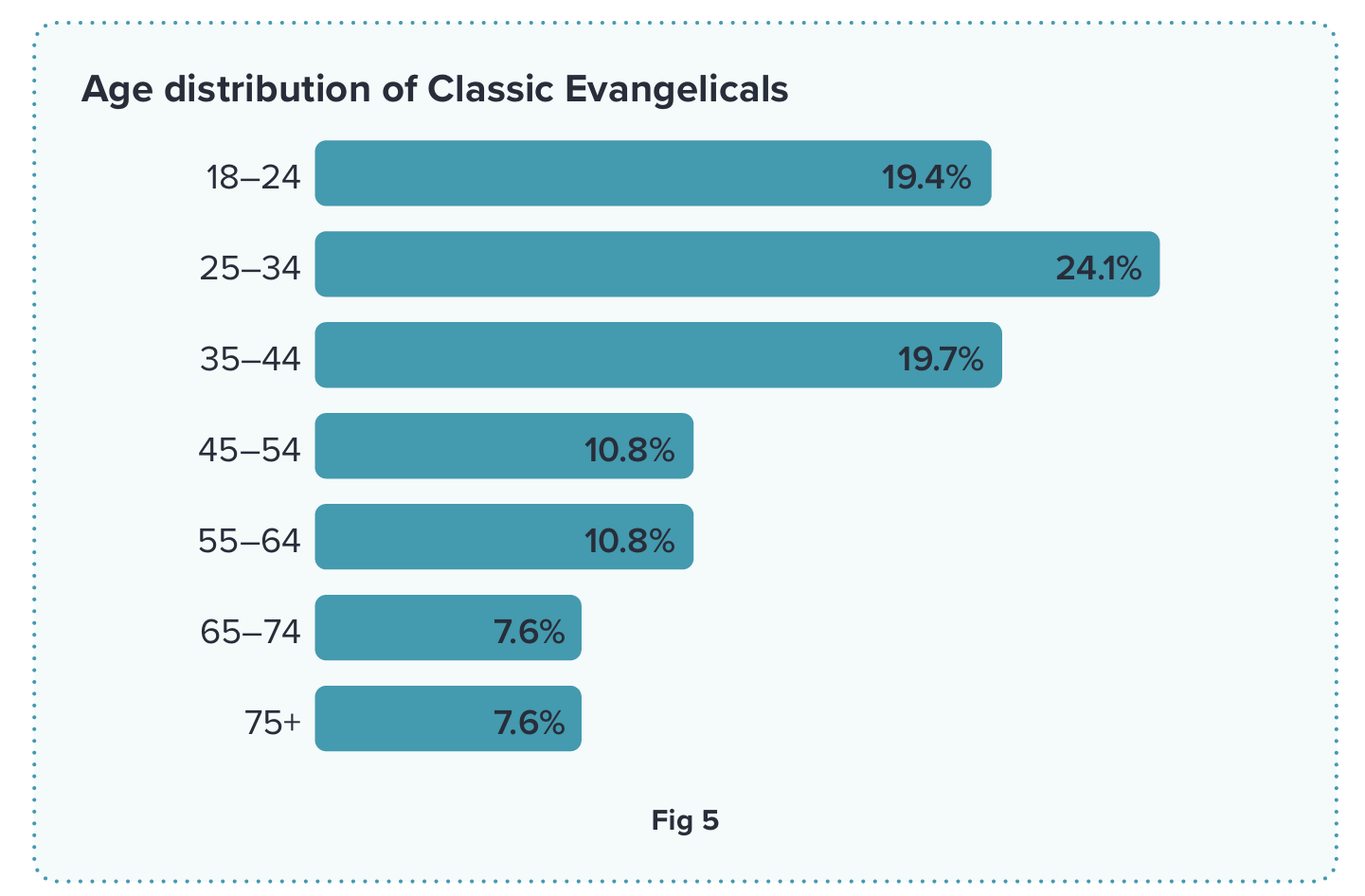
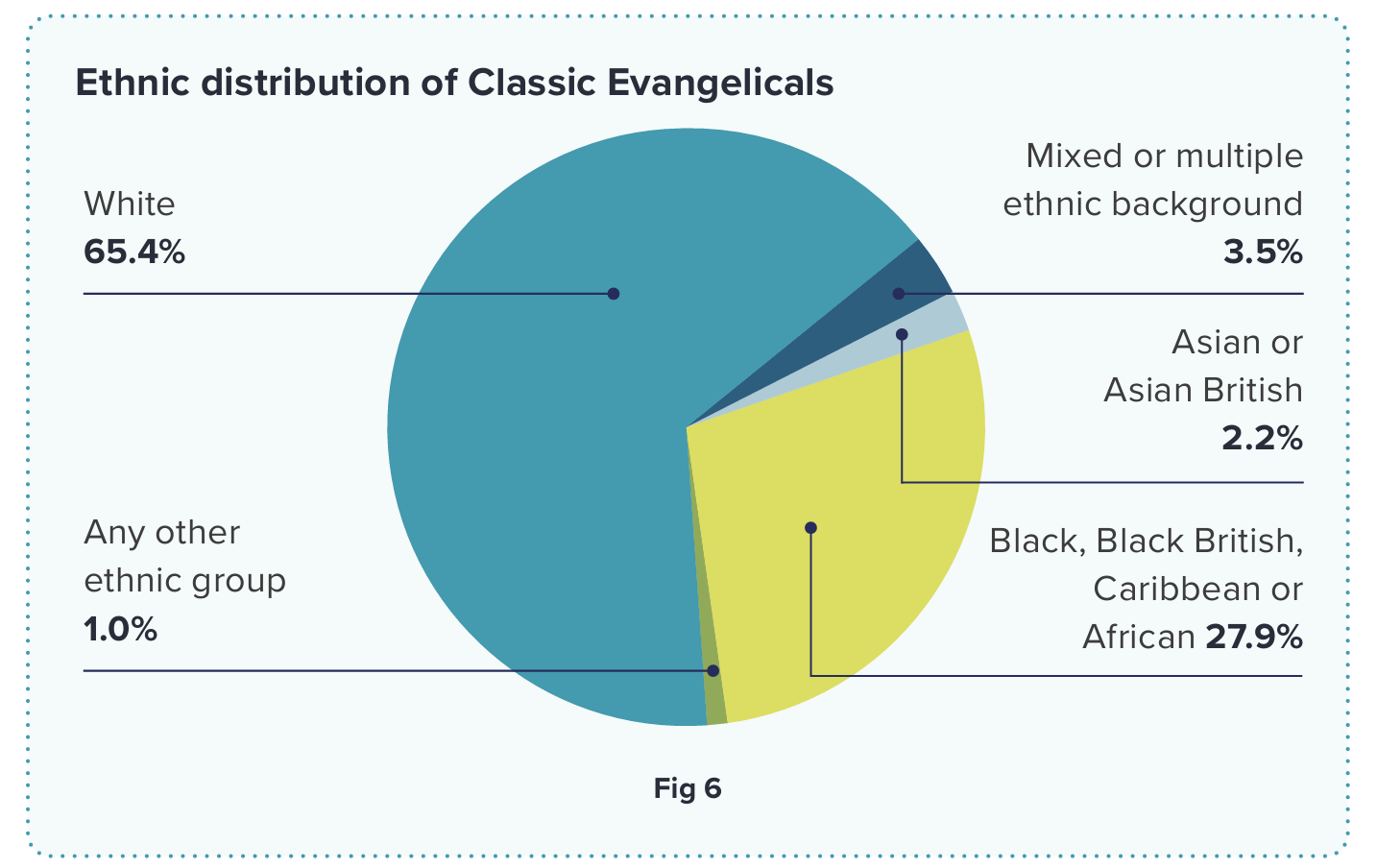
‘Broad Evangelicals’ comprise a majority of practising Christians in the UK today, at 68%. Evangelicals are a young constituency, with 44% under the age of 35, and ‘Classic’ evangelicals are more ethnically diverse than the general population, with more than 1 in 3 from an ethnic minority background as opposed to 17% of the general population.
-
Age ranges of 'classic' Evangelicals. Source: Understanding UK Evangelicals (eauk.org)
-
Ethnicities of 'classic' Evangelicals. Source: Understanding UK Evangelicals (eauk.org)
State of Theology (UK)
The State of Theology in the UK survey was undertaken by Ligonier, a US ministry committed to promoting Reformed theology.
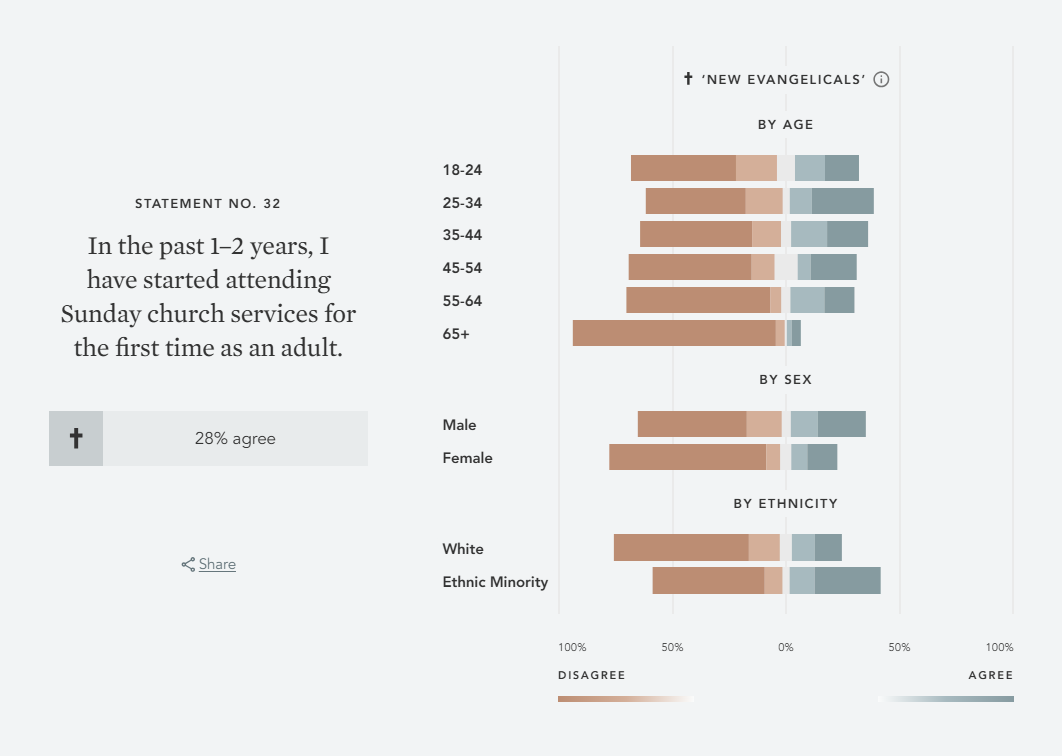
The surprisingly encouraging statistic they found was that 28% of UK evangelicals began attending Sunday church services for the first time within the last two years. These ‘new evangelicals’ are disproportionately likely to be younger and to be men.
This clearly suggests recent growth in the number of evangelicals, which aligns with the results of the EA research and our anecdotal experience of churches.
-
Demographics of the 'New Evangelicals'. Source: The State of Theology (UK) (thestateoftheology.com)
The Ligonier survey intentionally interrogated the doctrinal beliefs of those who are evangelical, and it is hardly shocking that relatively new believers have some confusion over issues such as whether Jesus is God and whether God accepts the worship of all religions. 15% thought the Bible contained helpful myths rather than being literally true.
This reflects the discipleship challenge churches face when there is significant conversion growth among people without a Christian background.
More worrying was the evidence of theological confusion amongst ‘established evangelicals’.
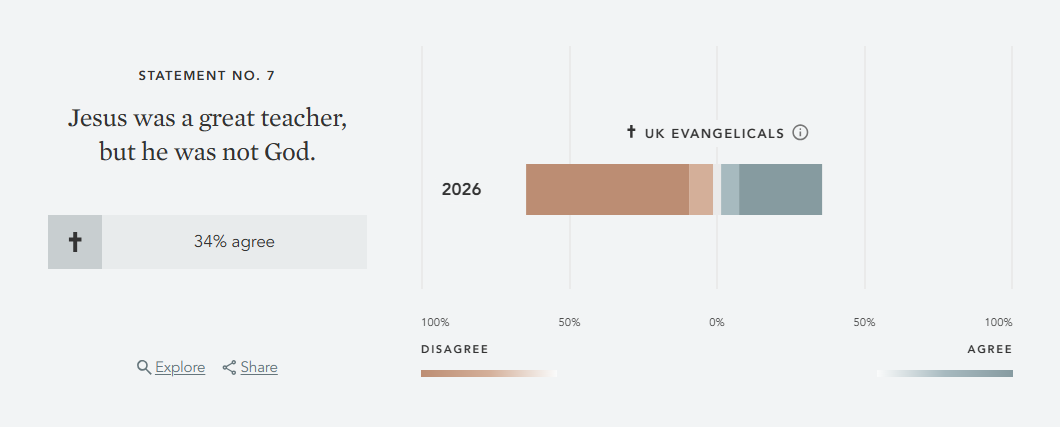
Of these, 27% believed that Jesus was a great teacher but not God and almost two-thirds believed that people are good by nature, rather than affirming the biblical teaching of our fallen humanity and corrupted hearts.
-
Evangelical beliefs about the deity of Jesus. Source: The State of Theology (UK) (thestateoftheology.com)
Before we despair too much, it is notable that the theological confusion of evangelicals in the most recent Ligonier ‘State of Theology’ survey in the US seems to be significantly higher than amongst ‘established evangelicals’ in the UK, which suggests that our churches are faithfully teaching and discipling those who have professed faith for some time.
Conclusion: growth but not revival
It has been famously said that "there are lies, dammed lies, and statistics", so what are we to make of the results of these two surveys?
Both organisations that undertook the research may have been influenced by their own needs and agendas in how they interpreted and presented the results. The EA has an interest in asserting that evangelicals are a larger group than previously thought, especially to the government and secular establishment, and Ligonier has a vested interest in showing that the great need in UK evangelicalism is more rigorous theological instruction.
Yet, I am thankful for the work that both EA and Ligonier have done in undertaking this research. It is a valuable service to UK evangelicals. The Bible is consistently interested in the numbers of believers, and counting both growth and the total membership of God’s people (for example, the book of Numbers and Acts). Accurate data identifies reality and prevents false claims, naive optimism, or unnecessary pessimism.
Data from both surveys confirms that the number of evangelicals is growing and that, contrary to expectations, evangelicals are younger, ethnically diverse, and majority male rather than female.
As non-evangelical churches continue their rapid decline, Christianity as a whole in the UK will become smaller overall but more evangelical in composition.
That said, however we assess the results, we remain a small minority of the population, which reveals the great gospel need of our nation.
Whether we take the number of evangelicals to be 3.8% ‘Classic Evangelicals’ or the wider 8% that the EA claims on its website, it still means that between 92-97% are lost and without Christ.
The increased growth we have experienced is encouraging, but it is not revival.
We need to redouble our efforts to keep praying and preaching the gospel to the overwhelming majority of our fellow citizens who are lost. That is the church's great task, and reliable evidence of some growth should not distract us from that task and the bigger picture.
There may be signs of spring for the gospel, but at present it is only the very first snowdrops pushing out of the soil. We long for a greater thawing and advance of the gospel.


