
AI and Church Ministry
There are both benefits and costs to using artificial intelligence. How can church leaders make the most of AI without using it to cut corners?

Artificial Intelligence (AI) is part of our everyday lives – both in ways we recognise and those we don’t.
AI drives much of the operation of our smart phones, online search engines, supermarket checkouts, banking, and many other things without us necessarily seeing that overtly. Many of us also more actively use AI to ask questions (“Hey Siri …”, “Alexa …”) or to teach us how to do tasks (can’t work out something on an Excel sheet? Ask Copilot!) or even complete a task for us (ChatGPT, please provide me with an illustration for the following sermon point…).
But barely a week goes by when there isn’t an alarming headline in the news about AI going rogue or taking over. In the past week, BBC News have held each of these headlines:
- “Could AI wipe out humans and how might it do it?”;
- “Not all AI workers think the tech could kill everyone”;
- “Google’s Gemini AI hacks three companies in security test”.
So how, as Christians and church leaders, should we approach AI?
How can we be wise and discerning in our use of a technology which is changing almost faster than this article will be published?
Engaging, rather than avoiding, is key. But many of us will rapidly feel out of our depth in understanding significant parts of the debate and will need to rely on expert advice and support.
AI expertise for Christian ministry
The AI Christian Partnership is a non-profit organisation made up of a variety of theologians (from a range of backgrounds), academics, and technologists who seek to encourage AI literacy amongst Christians through producing resources, guidelines, and training.
Alongside a wide range of other resources, the AI Christian Partnership have recently produced a set of “AI Guidelines for Christian Ministry”. The guidelines seek to take a “distinctly Christian approach to AI” and cover the benefits and costs of AI, ethical principles for the use of AI, and guidelines for good practice.
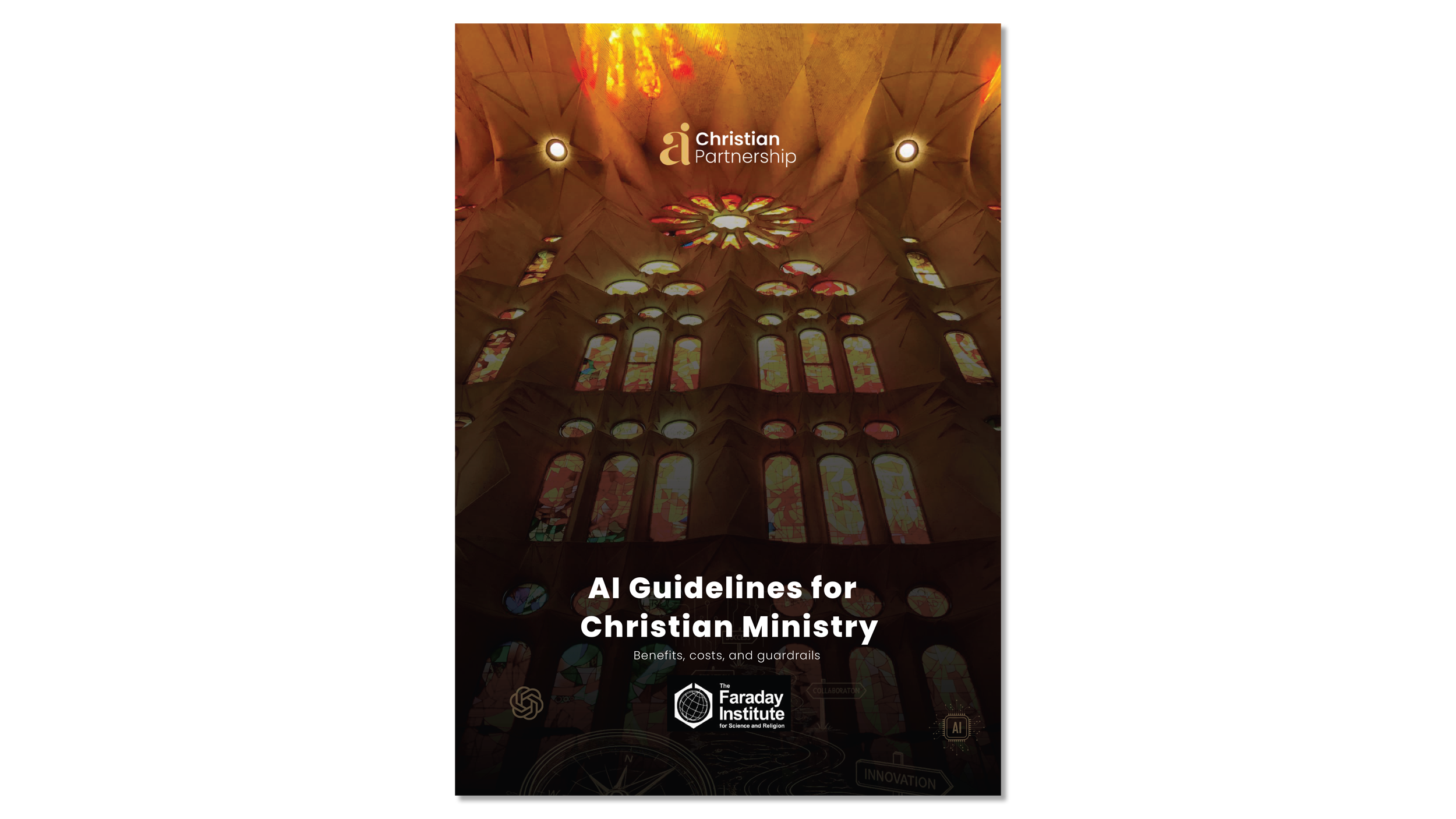
The guidelines focus on Generative AI which is the most common type of AI used today. Although Agentic AI and other advanced types are not covered directly, the principles in the guidelines offer help to approach AI as a whole.
The guidelines identify four areas in church life where AI has an impact:
- In the pulpit - from sermons, to prayers, to songs;
- In wider ministry - from small groups, to pastoral care;
- The church office and administration;
- Amongst the congregation using AI in their every day lives.
Benefits and cost
The guidelines challenge us to engage with AI. We need to recognise that if we don’t, we leave those in our church family to adopt AI with no Christian framework and to use guidance which does not hold a biblical worldview.
The benefits outlined range from simplifying meeting summaries to allowing individuals to hear the gospel in a way which is accessible for them - for example, in another language, with captions, or through simplified text.
These must, however, be balanced against the costs - including potential biases or errors, the devaluing of human distinctiveness, compromised spiritual formation, and many more.
Ethical principles
The guidelines briefly set out six ethical principles which might shape Christian engagement with AI:
- Transparency
- Privacy
- Accountability
- Caring for creation
- Human dignity
- The common good.
The additional resources linked in this area provide a valuable, more extensive consideration of the ethical issues surrounding AI.
Good practice
The good practice section provides a balanced practical consideration of how AI might be used well, taking neither an ‘avoid at all costs’ or ‘use for everything’ approach. They share eight practical things to guide our thinking when considering AI usage: from using the right prompts, to data safety, to treating AI like an intern, not an expert!
The guidelines provide an accessible overview of the opportunities and risks of AI use in a church context and provide a helpful framework for thinking through the wise and appropriate application of AI in our work and ministry.
There are links to further resources and training too, including a model church statement on AI use for churches to review, amend, and adopt if they wish.
With an opportunity to sign up for regular updates in this fast-moving area, the AI Christian Partnership offer a framework for meaningful engagement by church leaders with one of the hottest topics of the day.
Photo by Mimi Thian on Unsplash


